
Select
Choose consented creator-authored replies from routine intents.

Creator voice training workbook
The useful output is a small, editable style profile that captures how you write while keeping facts, boundaries, and sensitive history separate.
Built from product rules for approved facts, platform permissions, conservative handoffs, and creator-controlled automation.
Choose creator-authored replies from routine situations the assistant may actually handle. Include several ways you answer what you share, where people can find the official destination, a common follow-up, and a polite boundary. Ten relevant examples are more useful than one hundred unrelated messages.
Do not treat fan messages as examples of the creator's voice. Separate inbound text from the replies the creator authored, keep the conversation order needed to understand tone, and remove examples written by managers unless that operator is intentionally part of the approved voice.
Exclude payment details, addresses, legal or safety discussions, disputes, explicit personal disclosures, private names, one-off promises, and messages the creator regrets sending. A voice profile should not memorize secrets or turn an exceptional conversation into a normal policy.
Loresta's optional learning flow is designed to inspect a limited set of recent creator-authored replies, skip sensitive examples, and store an editable summary rather than the raw history as the persona. The creator can turn learning off and clear the learned profile.
Summarize the writing pattern into greeting style, sentence length, punctuation, emoji use, favorite phrases, and language to avoid. Add separate factual fields for what the creator shares, the official destination, and stable availability. Do not hide business facts inside a tone description.
Use concrete observations such as “usually one or two sentences,” “often starts with hey,” or “uses one fitting heart emoji.” Avoid vague labels such as authentic, engaging, premium, or human. The profile should be specific enough that the creator can disagree with one line and edit it.
Create a test set the model did not learn from. For each reply, score whether it answers the actual question, uses only approved facts, matches the creator's style, avoids unnecessary destination repetition, and stays inside the automatic-reply boundary.
A reply that sounds perfect but invents a detail fails. A factual reply that feels slightly plain can be improved safely. This separation prevents style tuning from hiding a truth or policy problem. Compare the output with the creator DM template library.
When the creator edits a reply, label why: too long, too formal, wrong emoji, repeated phrase, missing fact, unsupported claim, or should-have-handed-off. Then update the relevant profile field or rule so the next conversation benefits.
Review after the first twenty real replies and whenever the offering changes. Voice learning should remain optional, reversible, and bounded by the creator's current business facts. Read how natural DM replies use context after the profile is ready.
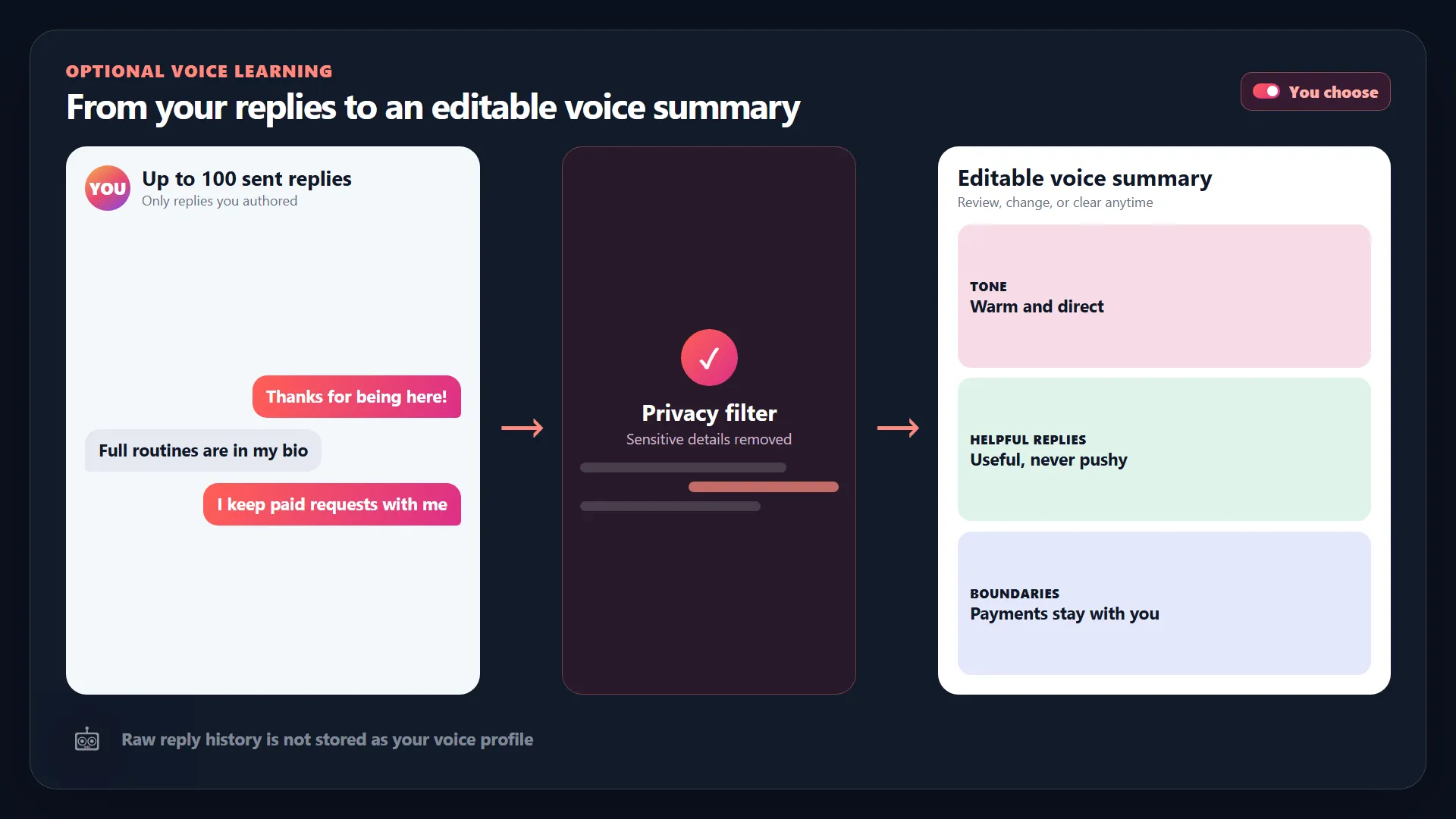
Editable instead of mysterious
A compact voice summary is easier to correct, remove, and keep current than an invisible persona assembled from unlimited raw history.
Use the smallest relevant set of examples, then improve through labeled corrections.
Choose consented creator-authored replies from routine intents.
Remove sensitive, exceptional, and manager-written examples.
Create editable voice fields separate from facts and rules.
Score truth, relevance, voice, brevity, and handoff behavior.
Every item should have an explicit yes before the learning job runs.
Direct answers for creators and operators comparing DM automation.
Start with ten to thirty relevant creator-authored replies across the routine intents you want to support. Quality and coverage matter more than a large raw archive.
No. Use consented creator-authored examples, exclude sensitive or exceptional conversations, and store a compact editable summary when possible.
Include greeting style, sentence length, punctuation, emoji habits, favorite phrases, language to avoid, and separate approved business facts.
Use unseen routine messages and score relevance, factual accuracy, style, brevity, destination repetition, and whether risky intent was handed off.
Loresta's intended control model keeps the learned summary editable and provides consent cleanup so learning can be turned off and learned profile data cleared.
Loresta turns consented creator-authored examples into an editable voice profile that remains separate from approved facts and safety rules.