

Custom commission pricing
How much should a creator charge for a custom commission?
Build the quote from the complete delivery job, then price revisions, rush work, rights, and fulfillment capacity separately. A defensible commission price describes what the buyer receives and what the creator can actually deliver.
Price the complete promise
A creator should charge enough to cover the complete delivery job, direct costs, revision risk, and the rights the buyer receives, while leaving a realistic capacity margin. Do not start with a follower count or a copied commission menu. Start with one sentence: “The buyer receives [specific work] in [format] by [date], including [revision boundary] and [use].” If the sentence is vague, the price cannot be defensible yet.
Custom work is different from a digital product because each accepted request can change the work. Ko-fi's commission guidance asks sellers to define what is included, how long work takes, how it is delivered, what is excluded, and what the refund or cancellation policy says. Those are pricing inputs, not administrative details. A ten-minute clarification, two rounds of feedback, and a new file format can turn a seemingly small request into a different job.
“Portraits start at $40”
The buyer cannot tell the size, number of subjects, detail level, revisions, delivery date, or use rights. The creator cannot tell which requests fit the starting price.
“One digital pet portrait, one subject, delivered in seven days”
The listing names the unit of work, the turnaround, and the boundary. Extra subjects, rush delivery, and commercial use can be evaluated separately.
Use the custom-request workflow when a message is still a question rather than an offer-ready brief. Use the support-page offer guide if a repeatable commission is not yet the right first offer.
Build the quote floor
The quote floor is the lowest price that makes the defined request worth accepting. It is not a market average or a promise that every commission will be profitable. Use a normal delivery, then identify the high-case work that can make the job run long.
| Cost line | Count this work | Question before quoting |
|---|---|---|
| Intake and planning | Reading references, clarifying the brief, checking fit, and reserving a slot | How much time happens before making begins? |
| Production | Research, sketching, recording, writing, editing, design, or preparation | What is one complete deliverable, not just the visible making step? |
| Communication | Progress updates, approval, revisions, file preparation, and delivery messages | How many responses and review rounds are included? |
| Direct costs | Materials, shipping, contractors, software, samples, or payment-related costs | Which costs happen only because this buyer accepted? |
| Capacity and recovery | Scheduling, a delayed reference, a reshoot, an illness, or a platform issue | Can one disrupted week be absorbed without breaking another promise? |
| Rights and use | Personal use, commercial use, source files, exclusivity, or a transfer | What control or future use is the buyer receiving? |
Use this formula as a planning floor: (protected hours × target working rate) + direct costs + risk reserve + rights or opportunity cost = minimum viable quote. Add a payment-processing or platform layer only after checking the current terms of the chosen checkout. Stripe's documentation shows why an invoice for one named customer and a reusable Payment Link are different tools, and why fulfillment still belongs in the operating plan after payment.
- 01
Time the whole job
Record intake, making, editing, revisions, file export, delivery, and the follow-up message. A short finished file can still require a long production path.
- 02
Choose a working rate
Use a rate that reflects business costs, non-billable time, taxes, experience, and the type of work. Do not present the rate as an objective market fact.
- 03
Add request-specific costs
List materials, shipping, assistants, licensing, or rush handling. Keep reimbursable costs visible so the buyer knows what changes the total.
- 04
Stress the calendar
Ask what happens if feedback arrives late or the creator loses one working day. Slow the turnaround, reduce scope, or limit slots before cutting the floor.
The floor protects the creator's time; it does not prove buyer demand. The digital-product pricing guide covers a different, more standardized offer. A commission needs the additional check that each buyer's brief can stay inside the defined unit.
Score scope and risk
Use this original decision artifact after calculating the floor. Give each factor a low, medium, or high rating, then resolve every high rating before accepting the request. The score does not set a price by itself; it shows where the quote needs a narrower promise, an add-on, a higher price, or a human review.
| Factor | Low risk | Medium risk | High-risk response |
|---|---|---|---|
| Scope | One format, one subject, one clear brief | Several details need confirmation | Rewrite as a fixed deliverable before quoting |
| Revisions | One consolidated round | Two rounds or several approvers | Set a paid revision boundary and a decision owner |
| Rights | Personal use | Limited commercial use | Define channels, term, territory, edits, and transfer or license separately |
| Timing | Normal queue | Specific event date | Price rush work only after checking capacity |
| Fulfillment | Digital delivery through one channel | Extra format or accessibility request | Confirm shipping, file, privacy, and support responsibilities |
| Buyer and claim | Clear buyer and factual request | Unclear use or promotional wording | Pause for identity, claim, safety, or legal review |
Resolve high-risk rights questions in writing. The U.S. Copyright Office says copyright initially vests in the author and that exclusive rights can be transferred separately; owning a print or downloaded file does not automatically transfer copyright. Circular 30 also explains that “work made for hire” has a specific legal framework. That means “you own it” is not an adequate commission term without saying which rights, if any, are granted.
Fixed brief, normal timing, clear use
The request fits the listed unit, the floor clears, and terms can be stated without an implied promise.
Extra subject, format, or rush
Keep the core offer and price the incremental work separately before production begins.
Open-ended feedback or rights
Rewrite the brief, cap revisions, and define the license or transfer before presenting a final quote.
Unsafe, unclear, or impossible timing
Protect the creator and buyer by returning a clear no instead of accepting a promise the schedule cannot support.
Set rights, payment, and terms
Put the terms beside the price so the buyer does not have to infer what was purchased. Ko-fi's first-party commission guidance recommends stating timing, inclusions, delivery, exclusions, and refund or cancellation terms before a request is submitted. Use the same discipline on any platform or checkout.
DeliverableOne [format, size, length, or number of items] for [subject], delivered through [destination].
TimelineDraft or final delivery by [date or range], provided the buyer supplies required references by [date].
RevisionsIncludes [number] consolidated revision round. Additional changes are quoted before work continues.
UsePrice includes [personal use or defined commercial license]. Source files, resale, paid advertising, exclusivity, or copyright transfer require a separate written agreement.
PaymentPayment is collected through [approved checkout] and work begins after [the stated payment condition].
ChangesState the cancellation, refund, missed-reference, late-delivery, and buyer-support path in plain language.
Stripe documents that Payment Links can be shared with anyone, while invoices are for a specific customer. That distinction can guide the workflow: use a reusable link for a fixed offer, and use a named invoice or approved intake when the price depends on a confirmed brief. Do not ask a buyer to send card details in a social DM.
If the commission appears in promotional content, keep claims supportable. FTC guidance says advertising must be truthful and evidence-based, and important qualifications should be clear and close to the claim. “Guaranteed likeness,” “delivered tomorrow,” or “commercial rights included” should not appear unless the creator can actually fulfill and support those statements.
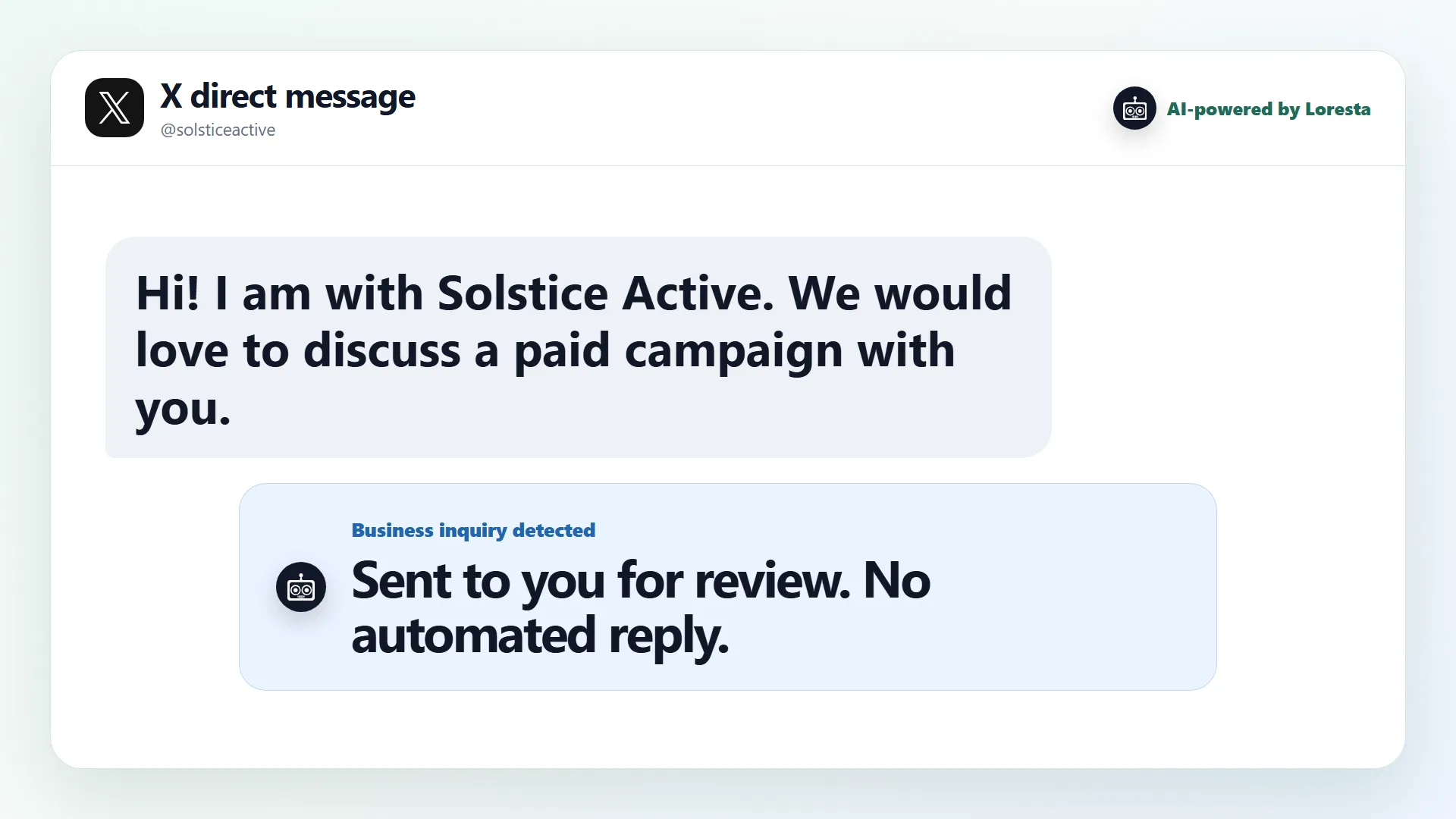
Loresta can classify likely custom intent, preserve the original message, and send an approved request for the brief. It should not negotiate a price, accept rights, ask for unnecessary private information, or promise a delivery date. The refund-policy guide is the next review when the cancellation path is not yet written.
Work through a commission example
Imagine a writer offering a custom 1,000-word travel itinerary based on a buyer's stated destination and interests. The numbers below are hypothetical planning inputs, not a market recommendation or earnings forecast.
Clarifying the destination, reviewing references, and planning the itinerary take 1.5 protected hours.
Drafting, fact-checking the supplied constraints, and editing take 3 protected hours.
Formatting, one consolidated revision round, and delivery take 1 protected hour.
The creator budgets $15 for a required map or licensed asset. The amount is illustrative and should be replaced with the real cost.
At a hypothetical $40 working rate, 5.5 protected hours equal $220. Adding $15 of direct costs produces a $235 floor before platform fees, taxes, extra rights, rush work, or a desired surplus. The creator should quote only after confirming the brief and rights.
Now test the risk matrix. Personal reading is low rights risk. A request to publish the itinerary as a travel company's lead magnet is commercial use and should become a separate license question. A request for delivery in 24 hours is rush work and should be accepted only if the creator can protect the promised quality. Five rounds of feedback are not a small variation on one revision; they are a new scope.
If the buyer cannot state the destination, intended use, or deadline, do not solve the uncertainty with a low starting price. Send a brief, hold the slot only under a stated rule, or decline. The number becomes more useful after the work unit is stable.
Publish one bounded offer
Run a small commission pilot with one request type, one delivery format, one revision boundary, and a visible slot limit. Ko-fi's guide specifically documents slot controls and seller-set terms; the underlying operating principle applies anywhere: capacity is part of the offer.
- Week 1
Write the listing
State the deliverable, examples, size or length, turnaround, price or starting price, revision rule, use rights, exclusions, and refund path.
- Week 2
Rehearse the handoff
Test the intake questions, payment path, reference upload, delivery destination, and buyer-facing update without using private social messages for sensitive details.
- Weeks 3 to 4
Measure the whole job
Record protected hours, revision count, direct costs, late references, support questions, delivery timing, and whether the buyer understood the scope.
- After the pilot
Keep, narrow, or stop
Keep the offer when the floor, scope, and capacity held. Narrow it when one risk repeatedly expanded the job. Stop when the promise requires work or rights the creator does not want to sell.
A good commission price makes the next decision obvious. If the offer is standardized and repeatable, put it on a creator support page. If every inquiry needs negotiation, keep the listing as an intake path and let the creator review it personally. Either way, price the promise that can be delivered, not the optimistic version hidden inside a vague request.
Research notes
Sources checked for this guide
Product details and policies can change. First-party pages were checked on September 1, 2026.
- Ko-fi Help: what are Ko-fi Commissions?
Ko-fi's first-party guide describes custom work and services, available slots, seller-controlled terms, delivery expectations, revisions, exclusions, refunds, and optional add-ons.
- Stripe Docs: accept payments online
Stripe distinguishes invoices for a specific customer from reusable Payment Links, and documents post-payment fulfillment, customer information, and recurring or one-time payment choices.
- Stripe Docs: create Payment Links with Connect
Stripe explains how payment, application fees, refunds, chargebacks, connected accounts, and fulfillment responsibilities vary by charge type in a platform workflow.
- U.S. Copyright Office: ownership and transfer
The Copyright Office explains that copyright initially vests in the author, that rights can be transferred in whole or in part, and that ownership of a physical object is distinct from copyright ownership.
- U.S. Copyright Office: works made for hire
Circular 30 explains the limited work-made-for-hire framework and why a commission should not casually be described as a work made for hire without checking the legal requirements.
- Federal Trade Commission: advertising FAQs
FTC guidance says advertising claims must be truthful and supported, and that important qualifications should be clear and close to the claim rather than hidden in fine print.
Questions creators ask next
Direct answers that keep the plan realistic.
How much should a beginner charge for a custom commission?
There is no honest universal beginner rate. Start with the full delivery time, direct costs, revision boundary, and rights the buyer receives. Choose a test price that clears that floor and is understandable for the buyer you want, then review the work after several completed commissions.
Should creators charge a deposit for commissions?
A deposit can reduce the risk of reserving time or buying materials, but the amount, refund rule, and point at which work starts should be written clearly. Use the payment method and consumer rules that apply to your location and offer, and get qualified advice for unusual or high-value work.
What should be included in a commission price?
State the exact deliverable, format, size or length, turnaround, included revisions, delivery method, and intended use. List add-ons such as extra characters, rush work, shipping, source files, or commercial rights separately instead of hiding them in an unlimited promise.
Should a creator transfer copyright with a commission?
Not automatically. Copyright ownership and a license are different decisions. State whether the buyer receives personal use, commercial use, a limited license, or a transfer, and ask a qualified lawyer about rights language when the work or fee is significant.
Can an AI assistant quote or negotiate a custom commission?
It should not. An assistant can identify likely custom intent, preserve the thread, and send an approved intake prompt. The creator or authorized manager should confirm scope, price, availability, payment, rights, private details, and acceptance.
Make custom work clear before it reaches the inbox
Loresta can surface likely custom intent and preserve the conversation while the creator decides the scope, price, rights, and delivery promise.